Cell-to-Body (CTB) Explained: How BYD's Structural Battery Changes the Game for Repairs and Insurance
Prepared by: The PrakanEV Team (Smith EV Broker)
Last updated: July 2026
Fact-checked by: Pol. Lt. Col. Weerayuth (Accident and Vehicle Structures Consultant)
1. Cell-to-Body (CTB): What It Actually Means in Plain English
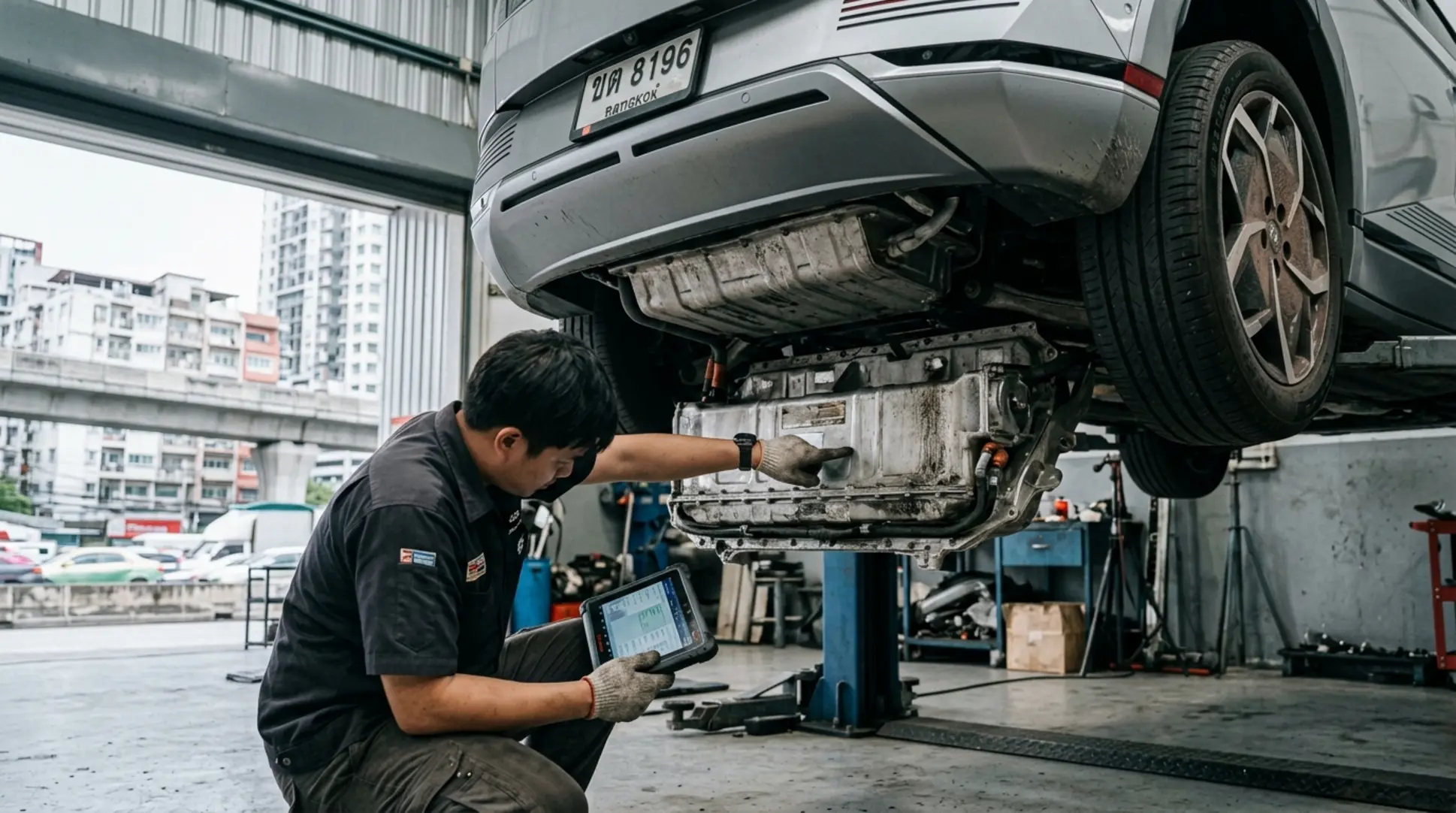
Think of how older EVs were built. The manufacturer took individual battery cells, packed them into modules, enclosed those modules in a big metal box (the battery pack), and then bolted that entire box underneath the car's floor. It is like strapping a power bank to the bottom of your smartphone — functional, but a separate add-on.
With BYD's CTB (Cell-to-Body), the engineers started from scratch. They embedded the Blade Battery cells directly into the vehicle's structural chassis. The top cover of the battery pack IS the cabin floor you put your feet on. The battery is no longer a passenger — it has become the backbone of the entire car.
🧠 The CTB Ownership Journey
From the day you buy to the day you maintain, here is the lifecycle you are signing up for:
2. Head-to-Head: CTB (BYD) vs CTC (Tesla) vs Conventional EVs
To understand just how integrated CTB really is, here is a direct comparison with the alternatives:
| Attribute | Conventional EV (Bolt-on Pack) | CTB — BYD Seal / Sealion 7 | CTC — Tesla Model Y |
|---|---|---|---|
| Cabin Space Efficiency | Moderate (thick floor stack-up) | Excellent (~10% more cabin volume) | Excellent (seats mount directly to battery) |
| Torsional Rigidity | Standard for the segment | Exceptional (>40,000 Nm/deg) | Exceptional (Giga Casting + structural pack) |
| Ease of Battery Removal & Repair | Straightforward — unbolt and drop the pack | Moderate to Difficult — requires certified BYD technicians | |
| Heavy Crash Risk | Replace battery pack separately; chassis unaffected | Chassis deformation can compromise the battery cover | High Total Loss probability (structural pack = structural damage) |
3. The Genuine Advantages of CTB — And They Are Real
- Sharper handling, flatter cornering: When the battery melts into the chassis, the car's center of gravity drops significantly. Combined with the sky-high structural rigidity, the Seal corners with a planted confidence that feels closer to a sports sedan than a family EV. The difference is not subtle.
- More spacious cabin than the exterior dimensions suggest: By eliminating the thick separate battery enclosure, CTB frees up vertical space. Even a sleek, low-roofed sedan like the BYD Seal delivers headroom and legroom that belie its coupe-like profile. Tall passengers stop complaining.
- Crash energy distribution is genuinely superior: The sandwich structure of CTB absorbs and disperses impact forces across the entire floor pan in a severe collision. This keeps the passenger cell intact better than a bolted-on battery pack ever could. In independent testing, the numbers back this up.
4. The Double-Edged Sword: What Happens When CTB Gets Damaged?
This is where every CTB owner needs to pay close attention. Because the battery and the cabin floor are now one piece, an accident that would be a straightforward repair on a conventional EV becomes significantly more complex. Hit a high curb hard enough. Get T-boned at an intersection. Scrape violently over a speed bump. The damage does not stop at the battery casing — it can propagate into the chassis rails and the main load-bearing structure of the car.
⚠️ What BYD Owners Get Wrong About CTB Repair Costs
A common assumption: "If a few cells are damaged, the technician can just open the lid and swap out individual Blade modules one by one. How expensive could it be?"
Here is the reality: CTB repair is not plug-and-play. If the battery's top cover — which is also your floor — has warped or twisted from impact forces, a technician cannot simply hammer it back into shape. Doing so would permanently compromise the car's torsional rigidity — the very thing that makes it handle so well and protect you in the next crash. In cases of severe structural deformation, the service center may deem the entire lower chassis assembly — including the complete battery pack — as requiring replacement. The repair estimate at that point will make your eyes water.
5. How Class 1 Insurance Handles This Advanced Construction
Given the potential repair costs lurking behind this technology, how are Thai insurers responding? The average Class 1 premium for a full battery electric vehicle (BEV) currently sits around 31,500 THB — notably higher than the ~17,700 THB average for combustion cars. The gap exists precisely because insurers are pricing in the risk of replacing these integrated high-tech assemblies. Here is what your policy absolutely must include:
📋 The CTB Insurance Checklist — Three Things Your Policy Must Have:
- Dealer Repair (Authorized Service Center) ONLY: This is non-negotiable. Independent garages do not have BYD's proprietary tools or the high-voltage training required to disassemble and reassemble a CTB structure safely. If an unauthorized shop touches that integrated chassis-battery assembly, your factory warranty evaporates instantly.
- Check your battery depreciation percentage: Verify whether your policy covers the battery at 100% replacement value (common in years 1-2) or follows the OIC's depreciation schedule (typically 90% from year 3 onward). Knowing this number upfront tells you exactly how much you would need to pay out of pocket for a new pack after a major accident.
- Total Loss insured sum must be adequate: Your coverage ceiling should be at least 80% of the vehicle's market value. If a crash bends the primary structure beyond economical repair, the insurer declares a Total Loss and cuts you a check. If you underinsured to save a few thousand baht on the premium, you will discover that mistake the hardest possible way.
These three outcomes vary by car model and insurer. If you are comparing right now, check the starting premiums and authorized-garage repair terms by model on the BYD Class 1 premiums page, which also covers the Seal and Sealion 7 with their CTB structures.
⚠️ Important: All statistics, premiums, and repair estimates in this article reflect market conditions and OIC regulations as of mid-2026. Actual figures may vary based on manufacturer promotions, individual driving history, and policy-specific terms. Always verify the details in your actual policy document.
Frequently Asked Questions About CTB Construction
1. If I drive through a flood, is the CTB structure more vulnerable to water damage than a conventional EV?
No. The battery pack and structural seals on CTB BYDs meet IP67 water and dust resistance standards — the same high level as other EVs. However, because the battery cover is your cabin floor, floodwater deep enough to submerge the floor pan puts not just the battery at risk, but the entire suite of interior electronics, seat motors, and wiring harnesses. Avoid wading deeper than half your wheel height regardless of what you drive.
2. If I scrape the undercarriage on a curb or a rock, does insurance cover CTB structural repair?
Yes. Scraping, bottoming out, or striking road debris counts as an external accident. Class 1 insurance covers the actual repair costs and genuine OEM replacement parts required to restore the vehicle to its pre-accident condition.
3. My battery degraded over time. Can I claim Class 1 insurance for a replacement?
No. Auto insurance covers damage from sudden accidents and natural disasters — not gradual wear and tear. Battery degradation is a warranty matter. File a claim through BYD's 8-year / 160,000 km quality warranty instead. The two systems serve entirely different purposes. Do not confuse them.
📚 EV Knowledge Hub: Related Articles You Might Find Useful
PrakanEV provides EV insurance for all brands — from BYD, Tesla and MG to the newest models on the market. See the full list on our homepage.