EV Totaled in a Crash? Here's What Your Insurance Actually Pays in 2026
Written by: Smith EV Broker
EV Insurance Consultant | I've walked too many owners through this exact nightmare
Fact-Checked & Verified
Reviewed by: Pol. Lt. Col. Weerayuth (Accident Consultant)

When Does Insurance Actually Declare "Total Loss"?
Think of it like a medical decision. When the doctor (the service center) tells you the treatment will cost more than just letting go, it's time to have that hard conversation. The iron rule is: if repair costs cross 70% of your insured sum, the insurer writes it off. They cut you a check for the full insured amount and haul away what's left of the car.
Let's say your EV is insured for 1 million baht. You crash badly enough that the service center quotes 750,000 THB in repairs. That's 75% — past the line. The insurer pays you (or your finance company) 1 million baht and takes the wreck. Sounds straightforward, right? Here's the thing: EVs hit that 70% line way faster than gas cars ever do. Here's why.
🔋 Reason #1: The Battery Alone Is Worth a Fortune
The battery pack is 30-50% of your car's total value. If a collision so much as dents the battery casing, most service centers won't risk repairing it (Thermal Runaway — battery fire — is not something anyone gambles with). They'll order a full replacement. And at 350,000-700,000 THB a pop, you've blasted past that 70% threshold on the battery alone.
🏗️ Reason #2: Gigacasting — You Can't Just Hammer It Out
More and more 2026 EVs use massive single-piece cast structures. Great for stiffness and weight. Terrible for repairability. Unlike traditional body panels, you can't knock a dent out of a gigacast piece — the whole thing has to be replaced. Parts plus labor? Astronomical. Another fast track to Total Loss.
Premiums and Coverage: What You're Actually Getting
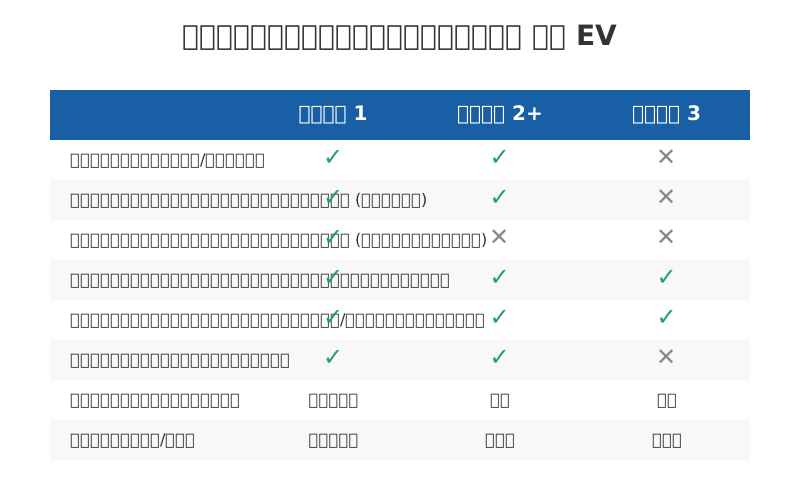
With repair costs this frightening, it's no surprise Class 1 premiums for EVs have crept up. For Asian brands, you're looking at roughly 16,000 - 45,000 THB per year. European premium models? 45,000 - 70,000 THB. If Class 1 starts feeling like a stretch, Class 2+ is a genuine alternative — it still covers car-to-car collision, fire, and theft, just at a friendlier price point. Here's a side-by-side:
| Key Coverage | Thai Paiboon 2+ EV | Viriyah Insurance 2+ EV |
|---|---|---|
| Vehicle Age Limit | Up to 10 years | Up to 10 years |
| Repair Type | Dealer / Service Center | Dealer / Service Center |
| Own Damage / Theft / Fire | 100,000 THB | 100,000 THB |
| Third-Party Property Liability | 1,000,000 THB | 1,000,000 THB |
| Annual Premium (incl. tax, approx.) | 12,900.99 THB | 13,000.00 THB |
🚨 The Fine Print That Can Wreck Your Claim
Buying expensive insurance doesn't mean you're covered for everything. These three clauses have caught more EV owners off guard than I can count. Read them. Know them. Act on them.
-
1Battery depreciation deductions are real — and expensive: In the first year or two, most policies cover the battery at 100%. But by year three, some insurers start calculating depreciation. If your battery costs 500,000 THB to replace, you might suddenly be on the hook for 20-50%. That's 100,000-250,000 THB out of your own pocket. Read the battery claim fine print carefully.
-
2Break the rules, void the coverage: Class 1 insurance covers accidents — but not normal battery degradation. And if you've modified the high-voltage system yourself, or deliberately driven through floodwater deeper than your car's rated wading depth? The insurer can (and will) walk away.
-
3Wallbox coverage isn't automatic: You charge overnight, a short circuit starts, and fire spreads into your home. A well-structured policy includes coverage for exactly this scenario. A bare-minimum one doesn't. Check before you need it.
💡 My Rule of Thumb (Smith):
Never, ever let your insurance lapse. Not even by a day. I'm not being dramatic — if you have a major crash during a gap in coverage, you're looking at EV repair costs that can easily outstrip the value of the car itself. Pay the premium. Sleep at night. It's the cheapest peace of mind you'll ever buy for something as expensive as an electric vehicle.
Related Articles
- EV Maintenance Tips 2026: What to Know Before You Drive
- Pre-Insurance Vehicle Inspection: What About Existing Scratches?
- EV Insurance Repair: Dealer vs. Independent Garage — Compared
- How to Claim Insurance for a Flood-Damaged EV

For a full overview of EV car insurance Thailand, including battery coverage, claim conditions and pricing, visit the PrakanEV homepage.