The Complete Blade Battery Guide for BYD Owners
Prepared by: The PrakanEV Team
Last updated: July 2026
Why trust this guide: We live and breathe EV insurance in Thailand. Every recommendation here is grounded in real claim data, real customer cases, and real conversations with BYD service centers across the country. No theory — just what actually happens on the ground.
💡 Thinking About Buying a BYD?
Before you sign anything, here are four things you absolutely need sorted:
- ✓ Warranty terms — what the service center actually covers (and what they do not)
- ✓ Class 1 insurance that specifically protects the battery — not just the car
- ✓ Wallbox & home electrical setup — 1-phase or 3-phase? Get this wrong and you are charging at half speed
- ✓ Battery replacement cost — know the number now so it does not blindside you later
1. Blade Battery: The 30-Second Summary
Blade Battery is BYD's in-house battery technology, built around LFP (Lithium Iron Phosphate) chemistry. The name comes from the cell shape — long, flat structures that look like blades, stacked directly together without bulky intermediate modules (what engineers call Cell-to-Pack). The upshot: a thinner battery pack that frees up more cabin space for you, and a chemistry that is dramatically less prone to catching fire than the NMC batteries found in many competitors.
What this actually means in your daily life:
- Safety you can genuinely feel good about: LFP is heat-resistant by nature. The nightmare scenario — a battery fire that cascades from cell to cell (Thermal Runaway) — is far less likely than with conventional chemistries. In a country where parking lots hit 45°C, this is not a nice-to-have. It is essential.
- More room inside the car: Because the pack is thinner, you get more legroom and headroom than you would expect from a car this size. Tall passengers will notice the difference.
- Built to outlast your ownership: LFP routinely handles over 3,000 full charge cycles before showing meaningful capacity loss. For most drivers, that translates to well over a decade of service before you would even think about the battery.
2. Blade Battery (LFP) vs NMC — How They Actually Compare
You hear "LFP" and "NMC" thrown around a lot. Here is what actually separates them in the real world — not on a spec sheet — for someone driving in Thailand:
| What Matters | Blade Battery (LFP) | NMC (Competitor Batteries) |
|---|---|---|
| Safety Under Stress | ★★★★★ — Extremely stable, resists thermal runaway | ★★★ — More heat-sensitive, needs robust cooling |
| Lifespan (Charge Cycles) | Excellent — 3,000+ cycles typical before meaningful degradation | Decent — roughly 1,500-2,000 cycles |
| Range (Energy Density) | Good — slightly less range per kilogram of battery weight | Better — more range for the same battery weight |
| Replacement Cost | Lower — simpler materials, easier manufacturing | Higher — more expensive raw materials |
| Hot Climate Performance | Built for it — thrives in heat, minimal cooling demand | Struggles without excellent active thermal management |
3. Which BYD Models Use Blade Battery?
Short answer: every single BYD sold in Thailand. There is no guessing — if it says BYD on the badge, there is a Blade Battery underneath. Click any model to see detailed insurance premiums and coverage:
| BYD Model | Segment |
|---|---|
| BYD Dolphin | City Hatchback |
| BYD Atto 3 | Compact SUV |
| BYD Seal | Sports Sedan |
| BYD M6 | Family MPV |
| BYD Sealion 7 | Premium SUV |
⚠️ The #1 Misunderstanding We See at PrakanEV — Do NOT Fall for This
Too many BYD owners operate under a dangerous assumption: "Blade Battery is super safe, super durable, and has an 8-year warranty — so if I crash, flood it, or dent the casing, the service center will just replace it for free, right?"
Wrong. And expensive — potentially half a million baht expensive. The factory Warranty covers exactly two things: manufacturing defects and gradual battery degradation (SOH drops below threshold). That is it. If your battery is damaged by an undercarriage impact, a flood, or a collision — the service center warranty evaporates. Gone. You are now 100% dependent on your auto insurance (Class 1) to cover a replacement. Choose that policy wisely.
4. Blade Battery & Insurance: The Claim Rules You Cannot Afford to Ignore
The battery is the single most expensive component in your car — 40-50% of its total value. Getting Class 1 insurance for a BYD is not just about checking the "dealer repair" box. It is about reading the battery fine print like your financial life depends on it — because it might. Here is exactly what you need to know before you choose a policy:
✅ When Insurance HAS Your Back
- Undercarriage collision: You clip a high curb, slam into a deep pothole, or road debris flies up and smashes into the battery casing — cracking, denting, or puncturing it.
- Major accident: A crash severe enough to bend the chassis and reach the battery pack. If the airbags deploy, assume the battery needs checking.
- Sudden, unexpected flooding: Your car is parked and flash flooding submerges it before you can move it. Or you are caught in rapidly rising water with no escape route. These are covered. Deliberately driving into a flooded road you were warned about? That is a different story (see below).
❌ When Insurance Walks Away
- Normal battery aging: Your range gradually drops over the years. Charging takes a bit longer. This is a warranty issue, not an insurance claim. Insurance does not cover wear and tear — full stop.
- You modified the high-voltage system: Tuning boxes, BMS reprogramming, unapproved electrical add-ons — any of these void both your warranty AND your insurance coverage. Do not touch the orange cables.
- You deliberately drove into deep water: You saw the flood warning sign. You saw the water rising above the curb. You went in anyway. Insurance adjusters have seen it all — they will investigate, and they will deny the claim.
OIC Rules Explained: Sliding-Scale vs 100% Battery Coverage
Under Thailand's updated EV insurance regulations (OIC), insurers are allowed to apply battery depreciation. In practice, this means your coverage splits into two tiers:
- 100% Coverage (No Reduction by Car Age): Add a Roojai battery add-on, or choose an Allianz Ayudhya plan that includes it. If the battery is damaged in a covered event, insurance replaces it in full, whatever the car's age. You pay zero and walk away with a factory-fresh pack.
- Standard Plan (Reduces with Car Age): Year one pays 100%, then coverage reduces about 10% per year per the OIC schedule. Example: in year three, a 400,000 THB battery replacement is paid at 80% (320,000 THB) and you cover the remaining 20% (80,000 THB) in exchange for a factory-fresh pack.
This depreciation percentage is not the same across insurers, and it changes the premium more than most owners realize. Check the battery coverage terms and starting premiums by model on the BYD Class 1 insurance page, which brings together the Dolphin, Atto 3, Seal, M6, and Sealion 7 in one place.
5. Charging: 1-Phase or 3-Phase Wallbox for Blade Battery?
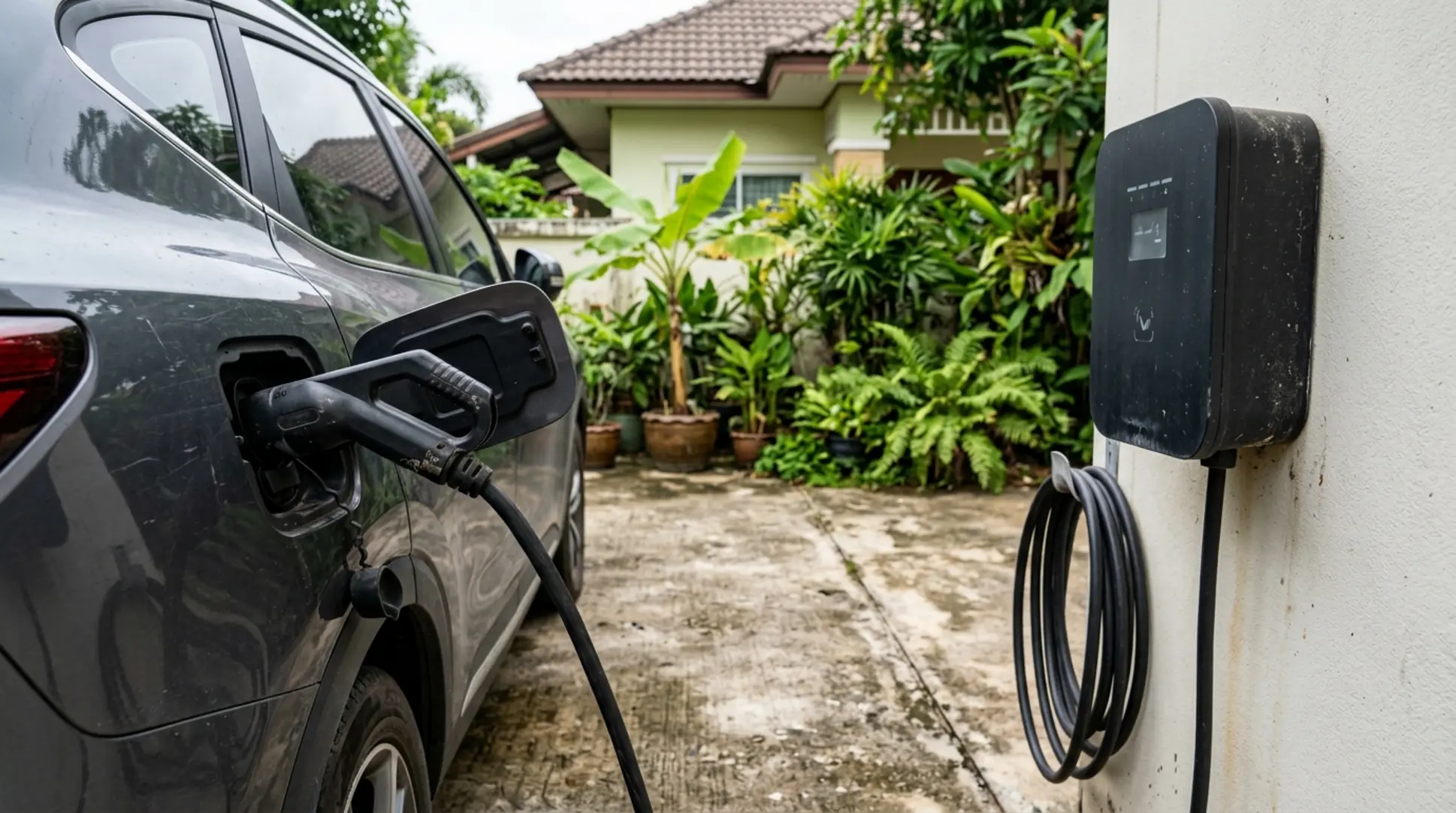
The right answer depends on one thing: your car's On-board Charger (OBC) rating. Get this wrong and you are either overpaying for capacity you cannot use — or worse, waking up to a half-charged car every morning. For a full breakdown, read our guide to 3-phase home charging. Here is the quick-reference version:
- 7kW Wallbox (1-Phase): Perfect match for the BYD Dolphin (Standard) and BYD Atto 3 (Standard) — both have 7kW OBCs. Cheaper to install, no meter upgrade hassle. Overnight charging gives you a full battery every morning for daily driving. This covers most owners.
- 11kW Wallbox (3-Phase): Worth every baht if you drive a BYD Seal, Sealion 7, or M6 — all equipped with 11kW OBCs and large batteries. A 1-phase setup on these cars will not fill the battery overnight. 3-phase future-proofs your home charging and cuts charge time by roughly a third.
6. Your Ownership Journey: The Full Picture
To connect all the dots, here is what the lifecycle of owning a Blade Battery BYD actually looks like — from the day you buy to the day you sell:
⚠️ Disclaimer: All cost estimates and warranty figures in this article are based on manufacturer specifications, OIC regulations, and Thai market data as of mid-2026. Conditions can and do change between model years and policy versions. Always verify the exact terms in your vehicle's warranty booklet and your specific insurance policy before making decisions.
7. What Is Next: Will Solid-State Replace Blade Battery?
The EV industry is absolutely marching toward Solid-State batteries — they promise even greater range and safety than today's best technology. But here is the reality check for 2026: Solid-State remains eye-wateringly expensive to manufacture at scale and is confined to six-figure flagship models for the foreseeable future. For the next 3-5 years, in the mass and premium-mass segments that most of us actually buy, Blade Battery will remain the dominant, most cost-effective standard for EV ownership in Thailand. If you are buying a BYD now, you are buying into proven, mature technology backed by millions of kilometers of real-world data — not a beta test.
Frequently Asked Questions
What exactly is Blade Battery?
Blade Battery is BYD's proprietary LFP (Lithium Iron Phosphate) battery technology. It puts safety first — dramatically reducing fire risk compared to conventional EV batteries — and its slim cell design gives you more cabin space. Think of it as the battery equivalent of choosing a Volvo over a sports car: safety and practicality over flashy numbers.
Which cars actually use Blade Battery?
Every BYD sold in Thailand: Atto 3, Dolphin, Seal, M6, and Sealion 7 — all powered by Blade Battery. There is no trim level or variant that uses a different chemistry. If it is a BYD, it has a Blade Battery.
How long is BYD's battery warranty?
8 years or 160,000 km — whichever comes first. This covers manufacturing defects and abnormal degradation. But — and this is critical — it does NOT cover accident damage. That is what your Class 1 insurance is for. Warranty = build quality issues. Insurance = crashes and collisions. Do not confuse the two.
Does insurance cover the battery if I scrape the undercarriage?
Most Class 1 EV policies do — but you must check the depreciation clause. Some offer 100% battery replacement with no deduction throughout the policy term. Others start reducing coverage after year 2. The difference can be 200,000+ THB out of your own pocket. Ask your agent this question directly before buying.
Can I claim insurance if a flood destroys my battery?
Yes — Class 1 covers natural disaster damage including flooding. However, your BYD service center warranty will NOT cover flood damage if you drove through water beyond the vehicle's rated wading depth. Insurance may pay for the repair, but your warranty ends there. The lesson: do not treat your EV like a boat.
My battery degraded over time. Insurance or warranty claim?
Warranty. Gradual capacity loss is a manufacturer defect/wear-and-tear issue — not an accident. File through BYD's service center. Pro tip: document your battery's State of Health (SOH) annually so you have a paper trail if it drops below the warranty threshold.
How much to replace a Blade Battery if I had to pay myself?
Approximately 350,000 - 500,000 THB for a full pack, depending on model and capacity (2026 prices). The smaller Dolphin battery sits at the lower end. Sealion 7 or Seal Performance Edition sit at the upper end. Either way, it is a life-changing amount of money — which is exactly why you should never cheap out on insurance coverage for the battery.
Is Blade Battery actually safer than NMC? Prove it.
Measurably safer. LFP chemistry is inherently more stable under the three conditions that kill batteries: impact, puncture, and extreme heat. BYD famously demonstrated this by driving nails through Blade cells without fire. Try that with NMC and you get a very different result. In Thailand — where your car bakes in 40°C+ parking lots and roads flood during monsoon — this advantage is not theoretical. It is practical, daily protection.
What is the water wading limit for a Blade Battery car?
The battery pack is IP67 rated — dust-tight and protected against temporary immersion. It handles normal wading within your vehicle's specification. But prolonged submersion above half the wheel height, especially in salty floodwater, is a recipe for a very expensive repair that neither your warranty nor your insurance will be happy about. When in doubt, park on higher ground.
Do I really need 3-phase electricity for a BYD Wallbox?
For Dolphin and Atto 3 Standard (7kW OBC): a 1-phase Wallbox is all you need — it charges fully overnight and saves you the meter upgrade cost. For Seal, Sealion 7, and M6 (11kW OBC): 3-phase is strongly recommended. A 1-phase setup on these cars means waking up to a partially charged battery. The 3-phase installation costs more upfront but pays for itself in convenience and charging speed from day one.
📚 EV Knowledge Hub: Essential Resources for BYD Owners
PrakanEV provides EV insurance for all brands — from BYD, Tesla and MG to the newest models on the market. See the full list on our homepage.