Home Wallbox Installation Cost 2026: The Full Breakdown — Charger, Wiring, and Everything In Between
Written by: Smith EV Broker
EV Insurance Consultant | I've been through this myself — more than once
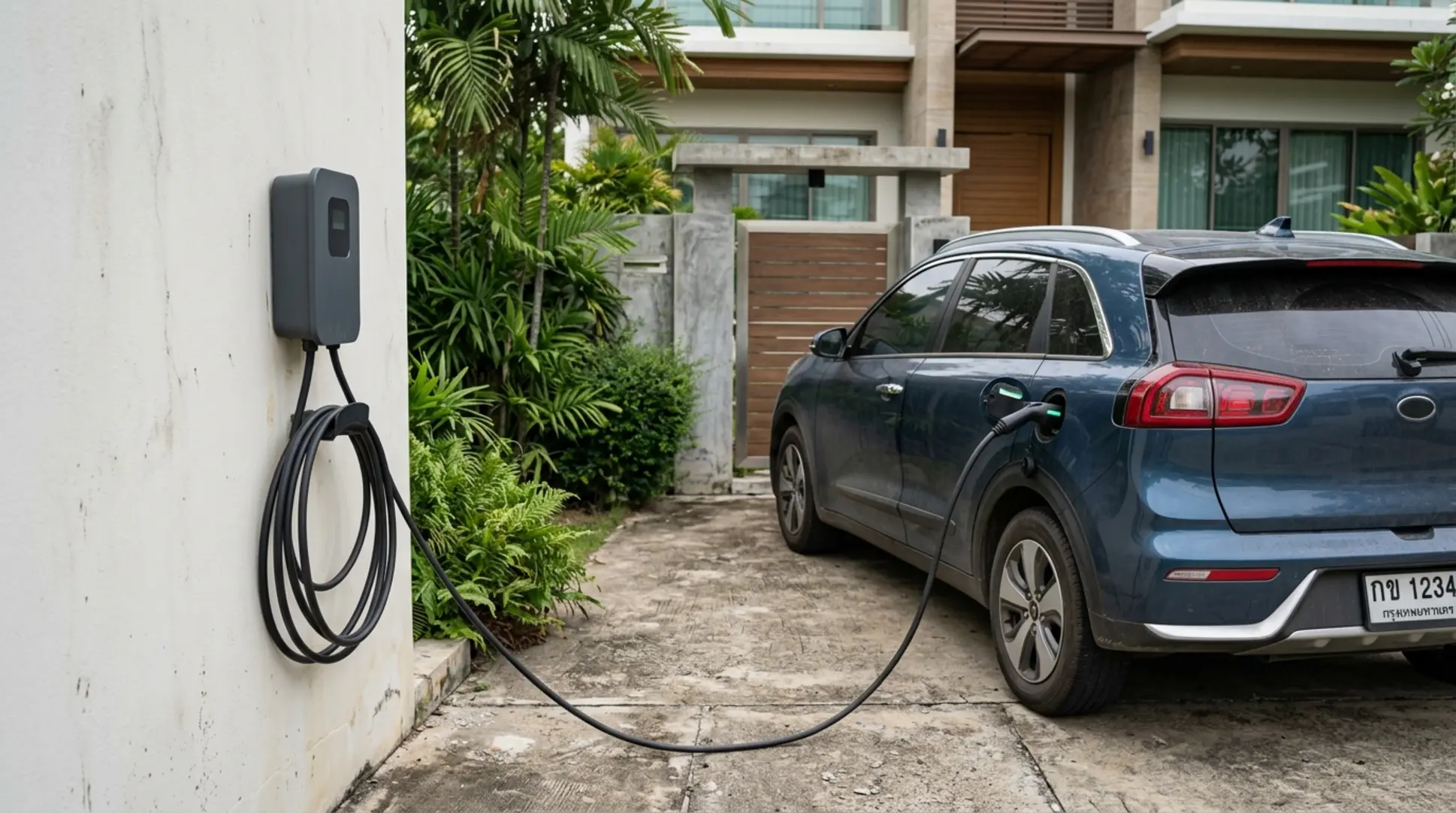

Let's Talk Real Numbers: Three Scenarios You'll Actually Face
I've broken this down into three real-world scenarios. Chances are you'll recognize yourself in one of them.
Scenario 1: Best-Case — The Car Brand Gives You a Free Wallbox
This is where most new EV buyers land. The promotion includes a charger and basic installation. But "free installation" usually means "free up to a certain cable length" — and it rarely covers the electricity authority fees. Here's what you'll still need to cover:
- 2nd circuit wiring (additional cable beyond the free allowance): ~9,000 THB (in this example, the cable run goes further than the included 10 meters, so the electrician runs a new dedicated circuit from your main panel)
- TOU meter upgrade (electricity authority): ~4,800 THB (switches you to cheap overnight rates)
- Wallbox unit and basic labor: 0 THB (covered by the dealership)
> This scenario: about 13,800 THB all-in. Plug in and you're charging.
Scenario 2: Older Home — Electrical System Needs Upgrading
If you live in an older house, your electrical panel may not be ready for the sustained heavy current an EV charger pulls for hours at a time. Forcing it without an upgrade risks voltage drops, tripped breakers, or worse. Even with a free charger, you'll face extra infrastructure costs:
- Load center + 20m heavy-gauge cable: ~13,000 THB
- Rewiring existing circuits to meet safety standards: ~6,500 THB
- TOU meter upgrade (electricity authority): ~4,800 THB
- Wallbox unit: 0 THB (free from car brand)
> This scenario: around 24,300 THB. It stings a bit more, but you're paying for the safety of everyone under that roof.
Scenario 3: Full Out-of-Pocket — You're Buying the Charger Yourself
This applies if you bought a used EV, a grey-market import, or you're upgrading to a smarter charger (like PlugHaus models). In 2026, a complete purchase-and-install package runs approximately 37,000 - 53,900 THB. Here's a reference price table:
| Brand / Model | Power | Price incl. Basic Install | Price incl. Install + 2nd Circuit |
|---|---|---|---|
| Delta AC Max | 7 kW | 37,000 THB | 46,900 THB |
| Delta AC Max | 22 kW | 40,000 THB | 53,900 THB |
| ABB Obsidian | 7 kW | 39,000 THB | 48,900 THB |
| Autel Maxi AC Lite | 7.4 kW | 49,990 THB (1-Phase) | 51,990 THB |
A lot of people wonder whether they need 3-phase power for a home EV charger. Short answer: it delivers more stable, faster charging. But if your house is already wired for 1-phase, upgrading to 3-phase means extra fees from the electricity authority for running new mains cable to your home — so factor that in before you commit.
Home Charging vs. Public Stations: Is It Actually Cheaper?
I hear this hesitation all the time: is it really worth sinking thousands into a home setup when I can just charge at the mall or the petrol station? Let me put it in perspective.
How Much Do You Actually Save Per Month?
Picture a 50 kWh battery, charging from 20% to 100%. At a public DC fast charger averaging 7.5 THB per unit, that's about 300 THB per session. Now charge the same amount at home overnight with a TOU meter (Off-Peak, 10 PM - 9 AM) at roughly 2.6 THB per unit: you're looking at just over 100 THB. Same charge, one-third the price.
According to GH Bank, charging at home 2-3 times a week saves you up to 2,600 THB per month compared to relying on public chargers. That means your ~10,000+ THB home electrical investment pays for itself in under a year. After that? Pure savings.
One Thing Most People Overlook: Insurance and Fire Risk
This one matters — a lot. After handling claims for years, I've seen the same nightmare play out too many times: a short circuit or fire starts at the Wallbox. The car insurer points at the home policy. The home insurer points back at the car policy. Meanwhile, you're standing in the middle with a burned garage and nobody writing a check.
My advice: when you're setting up or renewing either policy, ask your agent point-blank — "Does this cover the Wallbox equipment?" Some companies will add an endorsement for around 1,000-2,000 THB per year. Just pay it. That's a tiny price for knowing that when something goes wrong, someone's got your back.
How to Keep Your Charger Running Trouble-Free for Years
Installation done? Great. Don't forget about it. These chargers push heavy current for hours at a stretch — they work hard. Want yours to last? Here's what I've learned about keeping both your EV and charger in top shape:
- Never let the charging cable get sharply bent or — heaven forbid — run over by a car: The internal conductors can fracture. Replacement cables run into the tens of thousands of baht. Treat them with respect.
- Have an electrician test the RCD (safety breaker) every 1-2 years: It's a thousand-baht service call versus the alternative — a short circuit that travels into your car battery. And trust me, an EV battery replacement costs more than some brand-new eco-cars.
The Bottom Line
Before you sign that car reservation form, ask the salesperson one clear question: "Does this come with a free Wallbox? How many meters of installation cable are included?" That answer alone tells you how much extra budget to set aside. And whatever you do, don't cheap out by hiring a random handyman to do the electrical work. EV charging isn't like adding a few wall outlets — the current involved is serious business. Hire a licensed electrician who knows EV installations. Get it done right, once. Then sleep soundly every night knowing your car is charging safely right outside.
Related Articles
- EV Maintenance Tips 2026: What to Know Before You Drive
- Best EV Tires 2026: Which Brand? A Real Buyer's Guide
- EV Battery Replacement Cost 2026: The Numbers That Matter
- Why 3-Phase Power for Your Home EV Charger? The Honest Answer

Not sure what your premium would be? Use our homepage to check EV insurance premium estimates for your model in under 3 minutes.